


Calo, A., Oldham-Dorrington, O., Loring, P. A., & Johnson-Chappell, M. J. (2026). The legend of land sparing. Agriculture and Human Values, 43(4), 164. https://doi.org/10.1007/s10460-026-10985-4
Land sparing goes mainstream
A political junkie, I admit I follow with interest the argumentation of the “King of Liberals,” Ezra Klein. To me, Klein presents a perfect deployment of false wisdom laundered in the form of pragmatism. Klein’s logic often offers a daily defense of the status quo, trying to decipher what is politically possible instead of morally just or ecologically necessary. I listen to the podcast and read his articles because to know where the center lies and where it may be moving these days, Klein serves up regular indicators in well-produced and eloquent fashion.
The book Abundance is Klein’s most recent intervention, arguing for a more-is-less approach to solving our social and environmental problems. Housing shortage? Build more units. Climate change? Build more green energy. Crisis of poor health? Supercharge pharmaceutical innovation. A lot has been written critiquing this book. To be honest, I think it’s fine if Klein and co-author Derek Thompson want to deliver an argument that says governments should make more stuff available for the people by unlocking restraint on the “good” corporate actors. This is a clear match with their incrementalist brand of reformism. Maybe a politics that directs market forces to make popular things more cheap will be enough to win electorally. I’ll let others fight on this front.
I honestly think much of what bugs me about this particular intervention is the book’s title.
Offering up milquetoast permitting reform as a solution to housing and broadband equity failures is par for the course. By all means attempt to revive a politics of patching capitalism’s worst impulses. But to call this abundance? How dare they. How small and lackluster a vision for an alternate future. It’s no wonder that savvy centrists like Gavin Newsom and Josh Shapiro have openly taken up the abundance charge.
I can’t help but think about a scene from Joe Kane’s Savages (1995), a non-fiction account of Huaorani leaders struggling to maintain their autonomy as forces of modernization and oil extraction upend social and ecological relations in the Ecuadorian Amazon. Kane’s interlocutors frequently refer to the abundancia of the rainforest, as it provides basic needs as well as spiritual connection and the basis for cultural reproduction. The abundancia of the forest is in stark relief to what Kane calls an “outsider abundance,” a material provisioning of cheap things that continues to work its way into the life of the residents of the rainforest. In Quito, Kane encounters Nanto, Enqueri, and Salomón, on one of their delegations to meet with local officials. There, they go together to a Supermaxi grocery store to stock up on supplies for their visit. Kane writes:
I planted them in front of a bin of frozen chicken, dozens of plump carcasses skinned, plucked, wrapped in plastic, and displayed for the choosing. “Pick some good ones and put them in the shopping cart,” I said, and went to buy bread and fruit. I came back ten minutes later to find the cart still empty and the Huaorani standing almost exactly as I had left them. Briefly, I watched them from a distance: Nanto would whisper something to Enqueri, and Enqueri would whisper to Salomón, and one of them would start to pick up a chicken, then recoil. The forest seldom presented such an array of choices all at once: If the chickens had been wild turkeys, the Huaorani would have killed what they could and the rest would have fled. But a supermarket—that was abundancia of a whole new order.
I’ve always remembered this scene because grocery stores always fill me with immense sadness and existential unease. They say that we get carsick because the vestibular system detects motion while the eye interprets stillness. It is this sensory mismatch that causes motion sickness. In a similar way the supermarket provides a sense of health, material luxury, and gastronomic pleasure, while even a basic understanding of the food system sends strong signals of labor exploitation, ecological devastation, and marketing execs getting their hooks into you. If we are to survive in this world, abundance must mean more than the efficiency of production and carefree consumption.
The question for this essay, is where does the belief come from that intensification equals sustainability? How do well-read seemingly good faith journalists come to acept that efficiency will lead to equity and not more exploitation or extraction? How is it that a world of drone delivered grocery products is presented as a vignette of the utopian future, not a dystopian nightmare. One answer that jumps out at me comes from the cover—a rendering that Klein has suggested represents the vision of the Abundance movement. Klein said this of the image and vision:
Something we’re trying to do in the book, is that in the seventies, I do think one of the fundamental ruptures that happened in liberalism was between growth and the environment. The idea was that to grow more was to despoil the environment. Small is beautiful, the population bomb. Now the situation, we think, is the opposite. I mean, you could see it if you look at the cover.
When I first saw the cover, with my background in food studies, one rhetorical pillar of the abundance vision hit me in the face. The cover of Abundance is an absurd trope of the land sparing thesis.
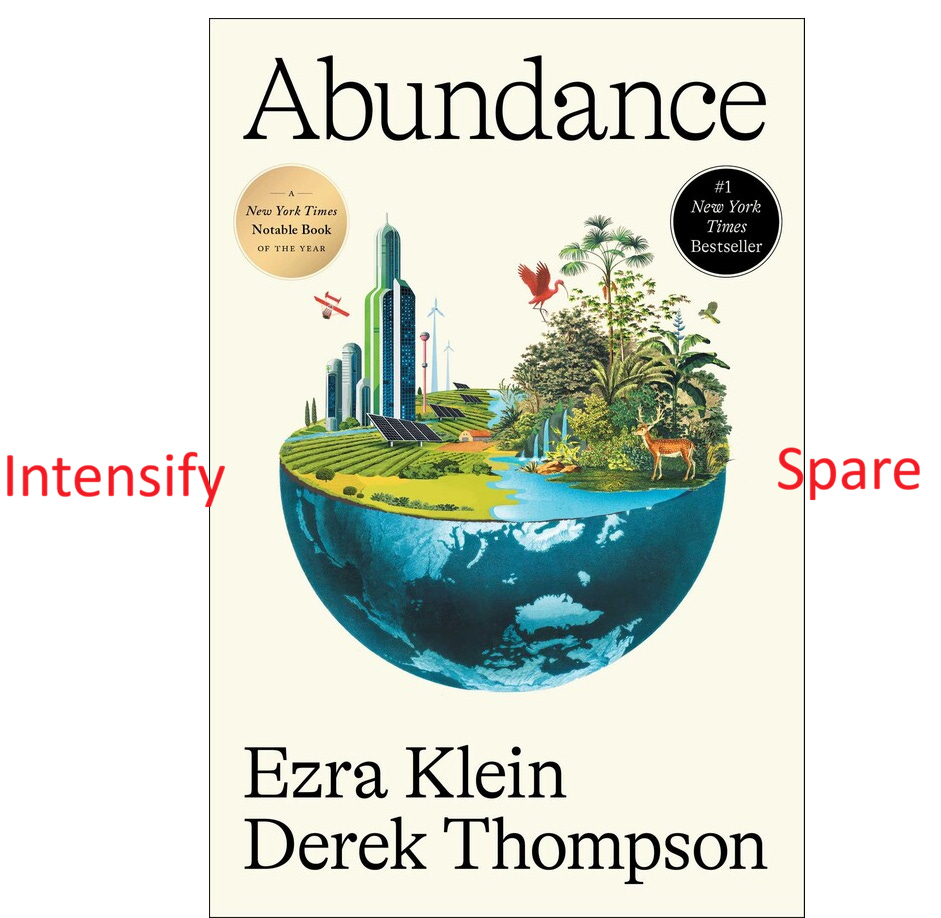
It is a comical rendering of a vision that intensity of production in housing, food and energy, frees up half the earth for wild nature. Compare this to ecologist Andrew Balmford’s checkerboard explanation of the optimal land use arrangement and the link is made clear.

Now, has Klein wallowed in the depths of the ecology and conservation biology journals as I was forced to do in my academic training? How is it that this idea that intensification leads to sustainability seeps out of the academic journals and into the mainstream?
About four years ago I wrote an essay about how land sparing seemed to be coming back into style. There, I suggested that the renowned conservationist Claire Kremen’s 2018 paper, Reframing the land-sparing/land-sharing debate for biodiversity conservation, ought to have been the last word on a spirited, yet esoteric academic debate. The reason I thought that Kremen’s paper should have been the end of the land sparing story was because it was so unendingly fair. For such a prominent ecologist to engage with land sparing on the premises of its own arguments and then suggest we take its best insights and methodological lessons forward, but still move on from its limited understanding of how land use dynamics play out in the real world—would appear the perfect place to draw a truce and work together to make landscapes work for both people and biodiversity.
How naïve I was.
The legend of land sparing
It appears that land sparing taps into something deeper. Worldviews about progress, about the separation of humans and nature, and about the pragmatic pathways for change neatly form new coalitions that continue to press this idea forward. Something new might be happening where a decades-long academic debate has now been subsumed by more powerful forces of narrative and myth.
And so, in a new paper co-authors and I tried to step over our immediate desire to throw a penalty flag against the latest boosters of a untroubled land sparing thesis (Ok, we do do this a little in background section). We examine closely recent land sparing rhetoric amongst think tanks like Our World in Data and amongst prominent environmental journalists like George Monbiot. Instead of merely arguing how the land sparing thesis is flawed, we tried to ask: how does this argument prove so compelling to different actors? Why does it endure and what are the implications for the debate about the future of food?
Calo, A., Oldham-Dorrington, O., Loring, P. A., & Johnson-Chappell, M. J. (2026). The legend of land sparing. Agriculture and Human Values, 43(4), 164. https://doi.org/10.1007/s10460-026-10985-4
We warn that land sparing is becoming less about ecology and more about myth and legend. Legends are hard to unwind, and land sparing isn’t the only one around in the world of sustainable food. However, the legend of land sparing forges an uncomfortable alliance between environmentalists, agribusiness, and food futurists—forming a durable coalition that could shape modern agriculture. Instead of more evidence about how intensification doesn’t always lead to ecological benefits, the terrain of struggle going ahead may be about producing countervailing myths about land, humans, and what is the meaning of abundance for all.
Despite the cover, it's interesting that the Abundance authors talk so little about agriculture itself. Because it's an industry where their wildest dreams seem to already have come true! And yet the problems of scarcity remain; food insecurity has not been eliminated, and our overabundance of food produces yet more problems.
I tried to flesh this out a little last year: https://toughgrowing.substack.com/p/on-abundance-in-american-agriculture
I'm not sure I understand your critique of land sparing itself.