


I was intrigued and entertained by the reporting from Heated, which scrutinized the explosive rise of the homesteading and good farming influencer Alexandra Fasulo.
The piece accurately reflected how the content about back-to-the-land, self-sufficiency, natural farming, and the plight of the rural is drawing wide popularity and interest these days.
The article also exposed a compelling dark side to this agrarian revitalization worldview—one that links an upholding of rural values with an aggressive defense of property against any type of intrusion. For Fasulo, the proposed solar development nearby her recently purchased homestead is a threat to sovereignty and an embarrassment to the virtue of individual rights. It represents a fear that “they” are taking “our land.”
This fear is central to right-wing social movements worldwide.
Take, for example, political commentator Eva Vlaardingerbroek appearing on The Tucker Carlson Show in 2022 to discuss her opinion on why farmers were protesting the Dutch government’s effort to regulate nitrogen emissions.
It’s very clear that the government is not doing this because of a nitrogen crisis. They are doing this because they want these farmers’ land. And they want it to house new immigrants. They also want it because the farmers are standing in their way of the Great Reset plans they have for us. Farmers are hard working, God-fearing and especially, self-sufficient people that are just standing in the way of their globalist agenda. There is only one thing we can call what [Prime Minister] Rutte is doing … and that is communism.
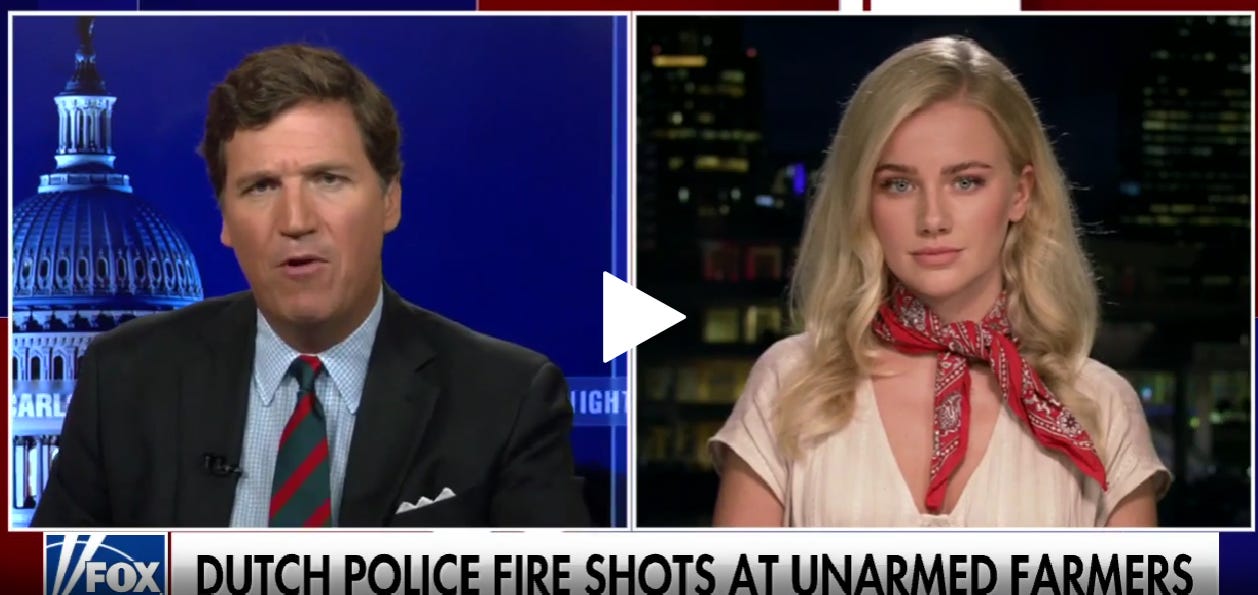
I’m not sure if I saw enough evidence in the Heated piece that Fasulo is some kind of conservative operative in the mold of Vlaardingerbroek. But the piece clearly showed that the deployment of rhetoric about defending farmland attracts both those who see sustainable food systems as a matrix of yeoman smallholders as well as those who make authoritarian claims of individual autonomy against the state and dominion over nature. These are uncomfortable bedfellows. Or at least they ought to be.
People throw around the term blood and soil nationalism, but they don’t often think enough about what the soil part entails.
A new publication
I’ve tried to do this thinking in a new article: Farmers and the Defense of Property.
My goal of the article is to show how the ideal of defending property has been a recent key to defeating environmental concerns of more equitable land management across distinct cases in the US, in the Netherlands, and in Britain.
Whether it’s how a right-wing political party in the Netherlands used fears over the government’s intrusion into farmer autonomy to defeat common sense nitrogen regulation, the launch of the ultra right-wing Restore Britain Party that props up the imagery of the noble family farmer as “proper Britain”, or the way that the Trump administration attempted to quash policy proposals to deliver land equity in an increasingly consolidated California, these cases all share a similar defining feature. They reveal the threat of property’s demise as a tactic to link right-wing social movements with broad farming constituents.
I make a second point in the paper. I argue this rhetoric is so successful because it creates a wedge within left agrarian politics. For those who see a future for sustainable food and emancipation through a world of smallholder agroecology, many would see a defense of property as aligned with their goals. What this creates is a vacuum, a rhetorical muddle that allows authoritarian actors to make claims to the defense of property without a coherent response amongst alternative food politics.
This leads me to my conclusion for a way out of this mess. Left agrarian politics ought to defend land, not property.
I conclude:
Right-wing social movements explicitly reference a defense of property to signify what is moral and what is just. A defense of property is a call to legitimize an individual’s claim to control and dictate benefits the land offers. A defense of land is a call to protect the relationships that sustain the flow of benefits between all humans and non-humans within a coherent bioregion or landscape. If the provision of healthy food is spliced from the yoke of property, threats to a loss of land value will lose its existential threat—and the siren call of authoritarian politics along with it.
Check out the full paper open access:
Calo, A. (2026). Farmers and the defense of property. Frontiers in Sustainable Food Systems, 10. https://doi.org/10.3389/fsufs.2026.1880848
This paper is part of a growing special issue on Right-Wing Social Movements and Agri-Food Systems: Political Priorities, Industry Beneficiaries, and Socio-Ecological Consequences. The collection will be worth following.
I strongly endorse the perspective of Adam Calo, who demonstrates how the prevailing paradigm of property ownership obstructs ecological reform. As Calo contends, a farmer's livelihood must no longer be contingent upon private land speculation; we must liberate land from market logic to create genuine space for an agroecological transition.
In the German speaking world a homesteading/back to nature magazine published by the far right is a strategy for luring people into their world. This is not new, but it is key.