

Property vs. the Commons
An interview with commons pioneer, David Bollier

De Biesterhof is a 25 hectare agroecological farm born into being through a laborious acquisition of farmland property. In 2022, a cooperative called Land van Ons (“Our Land”, in Dutch), deployed its land fund to intervene in the normal business of buying and selling. The fund is created by soliciting ownership shares from members who share a mission in improving the ecology of agriculture. It uses this aggregation of capital to buy land so it can install farm tenants who have the skills to deliver a biodiverse and regenerative food system, but don’t have millions of Euros laying around. When a farm property outside the town of Millingen aan de Rijn came for sale whose owner had no clear farming heir, Land van Ons jumped in to negotiate with the idea that their vision of agricultural stewardship would increase their chances of becoming the winning bid. Land van Ons acquired the land. The newfound power of ownership allowed them to call for applications amongst farmer tenants with aptitudes of regeneration. The Biesterhof, a partnership of three farmers, now grows perennial grains, runs a CSA with organic vegetable production, has planted over 10,000 trees, and is embedded in circular supply chains—an exemplar of diversified farming experts say is needed to turn the food system around.


As part of a summer school on Food Commons organized by Dr. Oona Morrow at Wageningen University, a group of students and I were hosted by de Biesterhof’s frontperson, Howard Koster. We were there to study the farm’s origin story, its governance structure, and to learn of its agronomic and gastronomic delights. Most of all, we were there to grapple with the enduring questions that arise in places like this: How can we make many more such Biesterhofs? Is what Land van Ons is doing a playbook that can be replicated? Or is this an “island commons,” a mere oasis of emancipatory relations carved out of a sea of private property and exploitation?
To answer these questions, I sat down at the farm with a heavy hitter in the world of commons, David Bollier.
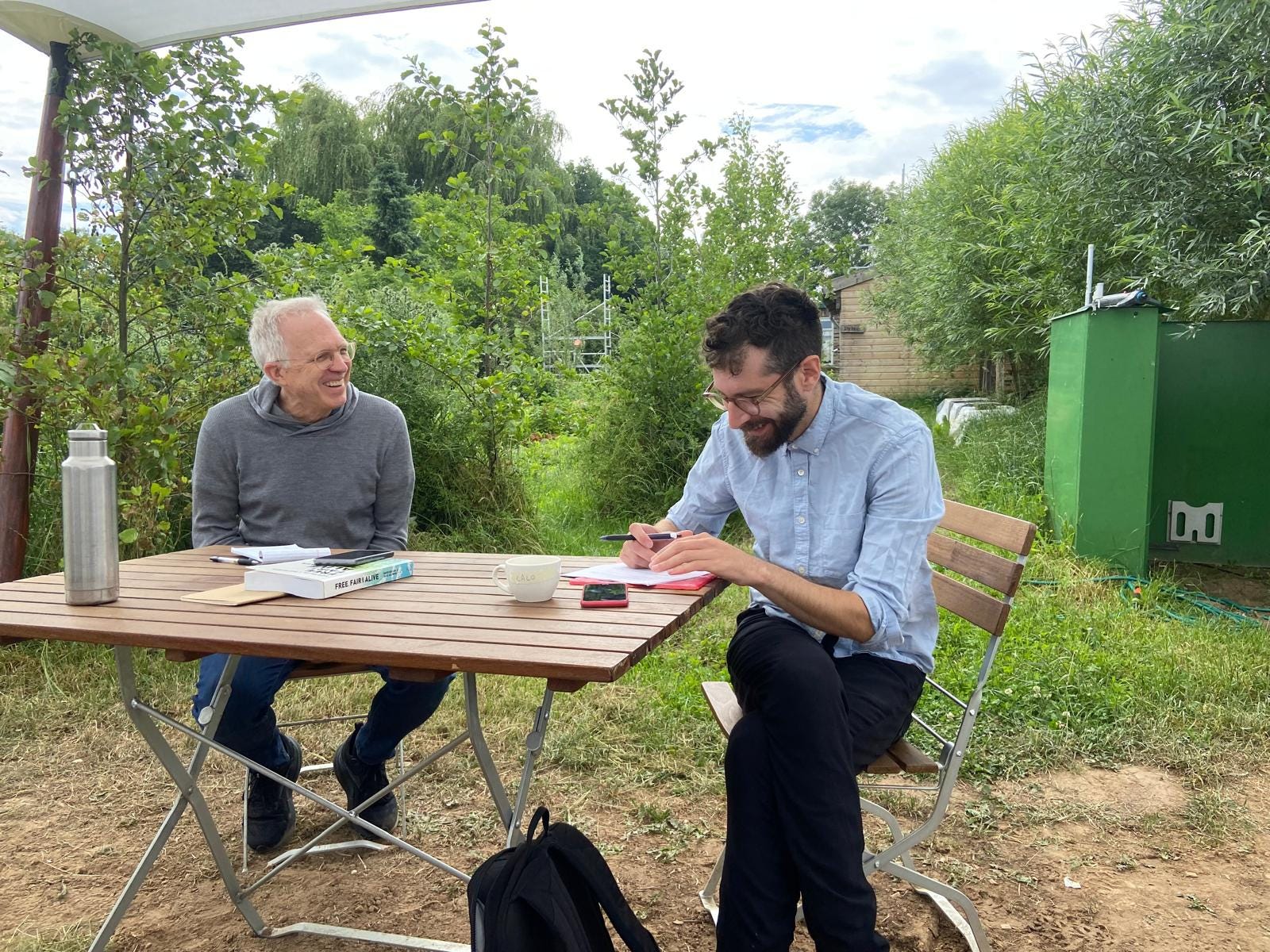
Bollier is an American activist, writer, podcaster, and blogger who is focused on the commons as a paradigm for re-imagining economics, politics, and culture. He is director of the Reinventing the Commons Program at the Schumacher Center for a New Economics, and is co-founder of the Commons Strategies Group, an international advocacy project. He has authored more than 15 books about the commons, and was awarded the Bosch Berlin Prize in Public Policy at the American Academy in Berlin.
Our conversation centered around a recent paper of Bollier, Relationalized Finance for Generative Living Systems and Bioregions co-written with long term collaborator Natasha Hulst. In our discussion Bollier explains his hope in the work of commoning, but also describes the way systems of property and price might interact with a vision of bioregionalism.
*Bollier contributed to editing the interview for clarity and depth.
The Interview
Adam Calo: I think the goal of the conversation here, David, is thinking about something Howard (our host at the Biesterhof) said. He said, “The other farmers are fixed in what they do.” We have been exploring how the relations of the commons are quite possible. They are everywhere. They are powerful, if we just see the world in a way that recognizes them. But, especially for the work I do, the question is, How do we transfer some of the assets and control from those farmers who are fixed in what they do over to commons? In the case of the Biesterhof, we heard that this effort to convert privately owned land and into commons was a difficult story. It took many years. And so I think the goal here is to struggle with that tension a little bit – knowing that commons are possible, but accepting that the systems and structures that do so are ultimately governed by property and price.
And in your paper that grounds this discussion, you offer one way of transfer, which is through this idea of relationalized finance. I think there are other ways of thinking about transferring these assets, but we will progress towards discussing this proposal.
David Bollier: Let me just elaborate on your excellent context setting because it’s actually larger than property and price.
It’s worldview. And I will introduce the philosophical term ontology. We’re talking about an ontological shift. That was precisely what Silke [Helfrich, Bollier’s late, long-time collaborator] and I, to our dismay, discovered in writing book Free, Fair, and Alive. We came to realize that the [Elinor] Ostrom approach [Ostrom was the renowned, Nobel laureate scholar of the commons] is grounded in the economistic framework of commons-as-resources. I don’t want to say this approach is “wrong,” but it is limited. Because we realized that the commons is a social system of relationality.
And so it’s not just price and property that collide with commons. It’s also a different worldview, one that imposes its view of reality on to a relational matrix that has different dynamics that capitalism and modernity. Price and property law privilege individual agency; see that agency as primarily “rational”; and see nature as existing separate from humanity. The issue, then, is finding ways to move from the essentialist, rational economistic framework into a deeply relational one.
What are the hacks, the workarounds, the cultural pathways to do that? I just wanted to expand your framing because while is entirely accurate that property and price pose threats to commons, the issues are even broader than that.
Adam Calo: Let me defend the system of property and price for a moment. When I look at some of the most promising models of agroecological land use, especially in the Global North and the US, these are happening on private property. These are incredibly productive lands. These are people who have achieved their long-term thinking through the security that was given by private property. Biggest Little Farm is an obvious example. Doesn’t that security given by property get people to plant trees, to start thinking about the land in generations and not just in the short term?
David Bollier: So far as it goes, yes. We also know that private property rights can also enable the destruction of nature. Garrett Hardin said famously that you need property rights for responsible control of the land. But we’ve often seen that capitalism as such is less interested in responsible stewardship than in market exploitation of nature, often resulting in rip-and-run behaviors.
So it’s more that property rights enable financial or monetary benefits than conscientious stewardship. Having said that, you’re also absolutely right that property rights in a ubiquitous capitalist system are often the only way you can secure land. So you need a kind of legal workaround if you want to function as a commons, as Howard [Koster, a principal farmer at Biesterhof] was talking about. His solution was to use a limited liability partnership to control the farm while attempting, eventually, to manage it as a commons.
I think the central but underdeveloped discourse should be, How do we develop these wormholes or pathways or workarounds between one system and the dominant western legal system? We’re not going get rid of Western jurisprudence tomorrow, and in any case, it has some benefits. Yet many of the stewardship practices that, say, indigenous cultures or commoners, are trying to achieve do need greater legal support. This is the gnarly conundrum that has to be dealt with.
Adam Calo: About stewardship. I think both commoners and private property owners claim to be acting as stewards of land. So there’s this discursive battle over stewardship that exists across different land relations.
David Bollier: Well, that’s an excellent point, but note that private property owners do not have the built-in structural constraints preventing them from externalizing their costs and risks onto others and future generations. The long-term control of the land, its long-term health, the relationality between humans and non-human life, and even relations among the community of owners – individual, disaggregated property holders often don’t care about such things. Which is why I like to talk about the “tragedy of market” – the failure of “rational individuals” operating in conventional markets to take steps to ensure long-term sustainability. Property law tends to overlook the rich, symbiotic, long-term relationships among living organisms and within ecosystems. Yes, property owners have a certain sovereignty to deal with these relations, but that sovereignty, grounded in individuality, is shot through with all these relational blind spots, and therefore value problems, that often go unacknowledged.
Adam Calo: But, is that really the case?
When I was studying at Colorado State University, the leading edge of conservation practice I was taught were these watershed partnerships. The idea was: “Let’s take all the landowners, they got these big ranches, but they’re not talking to each other. Let’s just get them to talk to each other,” and then they start to knock down their fences and let the elk cross. So can’t we simply encourage the landowners to just be better and think of their land as a part of a bioregion, and get them toward conservation?
David Bollier: Well, you you’re absolutely right. It’s possible. In fact, there’s a book by a property professor, Robert Ellickson, called Order Without Law, about cattle owners near Mount Shasta, in California. When cattle would wander off the land, instead of having to deal with his problem through state law or rigid rules or whatever, cattle owners would use social norms for dealing with the problem.
If your cattle degraded somebody else’s property too much, other property owners would inform your neighbors of your bad behavior, or sometimes just shun you. And so yes, there’s all sorts of things that can be done within the property system. The problem is that if it’s simply discretionary and good behavior is simply an individual moral or ethical choice, it’s likely going to be an aberration. It won’t have the same structural power as collaborative property regimes or a culture of commoning.
That’s why I think the law should be more supportive of commoning, rather than simply relying on aberrational, discretionary carve-outs of conventional property rights. For the time being, the best we can do is to encourage workaround legal or social innovations. It’s also true that there are other ways to secure these goals without necessarily relying on private property law.
Adam Calo: Before we move to some of these workarounds and to think about how we should consider them, what about price? How does price discipline what can be done on the land? Shouldn’t farmers who are doing all this extra work to bring in biodiversity, shouldn’t they receive the rewards of niche markets?
David Bollier: If you’re going to approach the whole thing from the perspective of price as the ultimate metric of value, yes. But the whole point of the commons is to establish a different regime of value. That gets us into a different set of expectations and criteria for appropriate compensation. In fact, the key point of farms like this one [Biesterhof] is to service its members, the other commoners who are associated with it, or the dozens or hundreds of owners of this land. In many ways, commons get you out of the trap of having to ramp up your market commitments and expenses. A lot of global markets are so expensive precisely because there’s so much overhead and transport and lawyers and layers of costs that you can avoid simply by becoming a commoner. I guess what I’m saying is that we can bypass some of those expensive, market-based logics by mutualizing ownership and management of things.
Adam Calo: Is there an intrinsic contradiction with the types of value generation that you would like to see through commons and the dominant worldview of property and price?
And if that’s so, if we live in a property regime that celebrates property and unleashes price on everyone, where does that leave us towards how to make more commons?
David Bollier: Are you saying that this is a stark binary? Because I don’t think it’s a stark binary. I think there’s a significant difference between capitalist-driven markets and markets in general. Take for example local markets. They tend to be more socially constraining and ecologically embedded than large capitalist markets. They’re not systematically organized to extract to maximum market value for shareholders, with the lurk threat that they will punish you if you don’t.
Normal market exchange can be benign, as can property rights. It’s just when you start to add the steroids of capitalism to property rights that things become more problematic. Because then, property owners are more capable of escaping accountability for your excessive, abusive behaviors, or for the despoilation of the land. Whereas community-bounded farmers operating at smaller scales are more likely to be respectful toward their neighbors and the local landscape. Industrial agriculture, by contrast, is more able to intervene in politics, policy, and law to change baseline legal requirements. I hesitate to invoke a global/local binary of “local markets good, global markets bad,” because geography is not the critical factor; it’s more that smaller, decentralized enterprises selling to regional or local markets tend to be more mindful of their social responsibilities than large, publicly traded corporations. A different logic can prevail at the local level, which is not so easily achieved in global markets, where an ethical “race to the bottom” is often more profitable.
Adam Calo: When our attention turns to ways of unlocking land, the land trust model comes to mind. Your work has focused on many variations of this. But the general model is you create an investment round to buy land at market price. Not far from here, there is another agroecology initiative that bought eleven hectares of land for two million euros, just for the bare ground to get started. So they start off on marginal lands.
How meaningful is this intervention? Is the aspiration of bioregionalism really to be pursued through this funnel of finding millions of euros in parcel-to-parcel battle?
David Bollier: I think this is primarily a cultural battle which will manifest with the money coming later. I also think that we shouldn’t trivialize small-scale affairs. One of the most moving experiences I’ve had as a commons researcher was meeting women in a village two hours outside of Hyderabad, India. They were bonded laborers on somebody’s else’s farm and could only afford to buy one meal of food a day for their families.
They emancipated themselves from that situation by recovering their mothers’ and grandmothers’ seeds from attics and safe boxes. The seeds were native to the area rather than imported Western seeds that needed fertilizers and other expenses to grow. With the help of manure and other things, they recovered some land on very small plots, which allowed them to grow enough food to eventually have two meals a day and to own their own land and seeds. It was one of the most moving experiences I’ve had when they presented their seeds to us, as visitors, treating the seeds as precious treasures. You could see the personal commitment and identity and love that was animating their seeds commons and crop-growing on a very small plot of land.
You could say that this sort of project doesn’t have scale, but I learned a great line a Belgian artist, Thomas Lommée, which goes: “The next big thing is going be a lot of small things.” I think scale is achieved by the federation and coordination of a lot of small things. Small things can have a huge amount of impact despite not being large, unified, or corporate. So, yes, maybe it’s a parcel-by-parcel battle by necessity. But I think that culturally once these things get a momentum, they start to attract other energies, other money, other similar commons. In other contexts, I’ve found that beauty and right livelihood becomes attractors in their own right. The support money and labor comes not as an investment or transaction, but as a ceremonial gift.
It may be too early to say how bioregionalism is going unfold, but I think this sort of cultural and psychic appeal will fuel its growth. The state in some locations may say, “Oh, it’s in our interest to support a bioregional approach” because there are all sorts of secondary benefits from resilience to local economic autonomy to biodiversity protection. But you are right, a formidable mind-shift and shifts in operational and investment funding will be needed to make this stuff work.
Adam Calo: But you are not too optimistic about the state. In the paper you write: “Changing dominant finance structures through state action, legislation, regulation, international treaties, is a non-starter for now.”
Couldn’t a strong green state direct bioregional economies? Why all this work tinkering with finance models instead of pursuing state reform?
David Bollier: Well, I guess there are several points to make. Green capitalism is not going to change the underlying logics. And we’ve also seen how green capitalism has had a huge number of iterations in different guises, from natural capital to cost-benefit analysis to sustainability to carbon offsets to biodiversity bonds. You could go on and on. But none of those have changed the core animating logics of growth and extraction, which is why they have had relatively limited impact.
In fact, you could argue that these iterations of “green capitalism” are more of a cover story than a structural transformation. I have serious misgivings about the capacity of green capitalism even though it may produce some beneficial things. It just won’t change the basic animating logic of the economy.
The other point I would add: The reason I don’t prioritize the role of the state is because when I reflect my own hard-earned experience as a commoner, the state doesn’t want to hear tell of an ontological shift or different logics. It is deeply committed to the market paradigm of growth and technological innovation. It has a deep, very cozy alliance with capital. It’s not eager to surrender that alliance, especially if it might mean less growth, meaning less tax revenue. Maybe it will act around the edges for political or gestural purposes, as a way to show a progressive face, but it is not going to domesticate capital to serve a green agenda.
That’s why I am so committed to developing the idea that Václav Pavel – the Czech dissident in the ‘70s, before he became president – proposed. He was asked, “How do you make progress when you’re in a totalizing system that’s not amenable to rationality or civic action?” – which increasingly is the story today as well. His answer was, “You create a parallel polis,” meaning a separate, alternative realm of horizontal relationships that embodies the values you want to enact. A realm that allows you to live honestly and to develop relationships on the terms you want, without having to self-censor or co-opt yourself from the get-go. The point is to build a prefigurative order that will begin to have its own organized, negotiating power vis-a-vis the state.
But if you approach the state now, with limited, unorganized power, you’re immediately going to be overwhelmed and co-opted. You’ll be annexed into the larger system and won’t have the transformational potential that you want to achieve. That’s why I’m skeptical about focusing primarily on the state.
Having said that, the state does have to be dealt with. The question is on what terms and how. There are, for example, efforts to forge commons-public-partnerships, especially in European cities. I think that’s worth exploring. But there are similar challenges.
A city government is more proximate to the people than a national government or international body. It can’t be a distant partner waving off citizen demands. City officials know the people more directly. There is a greater possibility of negotiating an acceptable partnership arrangement without it being exploitative. So I think there’s something to be explored with municipalities. But otherwise, in terms of national governments, I’d just as soon deal with the state later, from a position of relatively greater organized power, rather than now, when the understanding and commitment of politicians is likely to be limited or indeed, ideologically driven.
Adam Calo: And so in the absence of state, what I appreciate about this paper is how you turn to rethinking finance mechanisms. What struck me was your repeated use of the words “insulation” and “buffer.”
First, why not be more anarchist about it? Why do we need insulation from capital rather than outright rejection? Why not just live on our own terms without engaging finance and the trappings of green finance at all?
David Bollier: I think it’s both because commoners want to live on their own terms and they live in capitalist cultures. Let’s just be frank, there are certain practical limitations of growing a commons beyond a certain scale without money, without capital investment, without ownership, and, without some forms of state assistance or support, whether it’s subsidies or legal recognition or the validation that the state has to confer.
So, the buffer — the intermediary for relationalized finance — is meant to directly acknowledge that a different worldview and ontological logic operates in the commons, and it needs to be respected. The buffer’s role is to mediate between a commons and the state’s very different political and economic priorities.
I liken this to the way diplomatic embassies and diplomacy are buffers among nation-states, each of which has very different cultures and priorities. To ease the tensions caused by difference, certain international diplomatic protocols have arisen in order to temper the raw power of one player versus another, and foster mutual respect. International law is designed to uphold the sovereignty of states with respect to each other. I think buffers for relationalized finance can play that role. The state can’t just say, “We’ve got the money. We’ve got the elected officials. We’ve got the legal power. Screw you.”
Having this intermediary space matters. I came across an example in my research of the French military in North America during colonial times. They kept encountering Native Americans, and each side realized they needed stuff from the other, things and assistance that only the other could provide. They needed to work out an intermediary third space of respect for commerce and commons without either party insisting on an exclusively French or native attitude. Having that intra-collaborative space is important because it acknowledges different identities and roles while recognizing that each side needs the other.
Adam Calo: The general idea of relational finance is a mechanism to spur new types of value at the bioregional level.
In the paper, you and Natasha Hulst provide eighteen principles that would characterize relational finance. Can you bring this to life? And throughout those principles I noticed a strong emphasis on locality — that seems central to bioregionality.
In the food systems debate, there is a strong pushback against the local right now, arguing that what we eat matters more than where it comes from. I find much of this eco-modernist and reactionary. But at the same time, I do wonder if local good, global bad is too simplistic.
David Bollier: First of all, let’s acknowledge we’re not going to become completely local. There are things we will need from outside of our region.
The point, however, is that a bioregion should try to become more economically self-sufficient and more ecologically appropriate, if only to start to diminish the carbon transport costs and the infrastructures associated with them. There are also social practices and cultural dimensions for “becoming bioregional.”
This is about place-based commoning, and not just being a passive consumer or investor. It’s about agroecology and other forms of relationality with the more than human world. To the extent people need things from outside their region, cosmolocalism offers rich possibilities. This term refers to open source design and knowledge sharing on a global scale, but the local production of physical things.
There are lots of different examples of this, but I think in the agricultural context, the System for Rice Intensification (SRI) is a good example. This is a project of farmers sharing their insights into the agronomy of rice-growing on an international scale. It consists of subsistence and small-scale farmers from Sri Lanka to Cuba to India sharing techniques and knowledge for improving their rice yields in organic, eco-friendly ways. Agriculture professionals and agricultural ministries have pooh-poohed this collaboration, but in fact it’s proven to be remarkably effective.
SRI maybe isn’t the best example of cosmolocalism because it’s not producing a distinct physical artifact. Cosmolocalism generally refers to the collaborative design of such things as motor vehicles, furniture building, pharmaceuticals, and many other things that you would not imagine could be internationally designed, and locally produced, through open source sharing. So this is another way of navigating the global/local divide.
Escaping the conventional structures of modern capitalism — through participatory decision-making, accountability at appropriate scales, and horizontal rather than hierarchical governance — has its own merits. “Commitment pooling” as a way of socially coordinating people’s approaches, for instance, grounds and legitimizes bioregional activity. Relationalized finance should be seen in that larger context.
Adam Calo: You introduce something called the regrantor model — a concrete way this relationalized finance structure would work. This includes transvestment, as opposed to conventional investment as a central concept. Can you explain the regrantor model? How is it different from, say, a social bank or a microcredit scheme with a good cause?
David Bollier: The difference is that regrantors are the chief decision-makers. Commoners themselves, as elders of a commons community, are allocating funds. They are not applying conventional finance or progressive finance criteria. Because they are peers and collaborators with the commons world, they have a keen understanding of the different factors for growing a commons. Conventional, financial metrics are designed for capitalist enterprises and market growth.
Adam Calo: And how does a regrantor model function in practice?
David Bollier: That is a work in progress. Next week, in fact, the AmsterDOEN Action Program, an Amsterdam city office concerned with community economies and innovation, is hosting a workshop next week (on June 23) to discuss these very issues. The program doesn’t have a formal commitment to start such a regrantor arrangement, but they are seriously entertaining it and have had serious conversations about it, including the city’s potential role, whole role NGOs or commons groups could play as decision makers, etc. This is something we have to invent.
“Transvestment” is a term we coined to show that money is moving from capitalist circuits of value into commons-based circuits. The point is to signal that the money is transferred to a different realm of value and investment.
So there isn’t the usual return-on-investment expectations that a normal investor would require. The idea is that if you’re transvesting money, you recognize the different value proposition that a commons entails. That’s okay with you — in fact, you recognize that’s the transition we need to make to get out of the growth economy and all the pathologies associated with it. That’s the scenario. The bioregional finance movement, and especially the BioFi project, is exploring precisely this – how a bioregional finance facility, or BFF, might be structured to neutralize some of the conventional expectations of finance capital. How to make it more willing to accept different ground rules for investing money in a bioregion? The returns won’t be as high as conventional investment, at least for now. But you are likely to get a more stable community, a more resilient ecosystem, greater biodiversity and many other values that conventional investment markets don’t even recognize. So that’s the logic behind transvestment.
Adam Calo: Let’s say you have, you have bioregional circuits of value motivating bioregional action. How do those circuits interact with the broader systems of care required for social reproduction? Put simply: in a bioregional world, can you produce surpluses sufficient to support care of the elderly or the young? Or does that require negotiation with the state? Or does social reproduction itself migrate into commons circuits?
David Bollier: State support of care is what is now threatened, as we see through neoliberal austerity politics. There’s no longer a political willingness, at least among the dominant political classes and capital, to fund those needs. The surpluses are no longer there for the state to redistribute, and they are being politically choked off by the Elon Musks and Trumps of the world. That proposition, the social welfare state, which once had consensus, is under siege. Having said that, it’s important to note that there are all sorts of social care that can and should be mobilized in different ways. Instead of seeing care as a market service measured in units of productivity as driven by money and bureaucratic systems, care needs to be seen as a socially rooted, interpersonal phenomenon.
People are so alienated, lonely and starved for connection that we underestimate the role that socially driven care could play in meeting real needs. Now, I don’t want to say that as a blanket proposition because care does need state support, and there are certain specialized needs that require ongoing, focused attention. But there are ways to support care without making it a commodity-service best performed by robots. I think of the neighborhood nursing company in the Netherlands, Buurtzorg, which does receive state support, but the character of the care provided is not the rigid, productivity-driven industrial model that prevails, for example, in the US. It’s more flexible, humane, and caring – and it has been shown to produce better therapeutic results.
Or consider Japan’s intergenerational time banks for care, where younger and middle-aged people provide care to the elderly and accumulate credits redeemable when they themselves are old. I think it’s a fascinating idea because it’s reached a certain scale and establishment that it’s seen as a serious non-market form of providing care to people. We need to have more innovations along these lines going forward, especially as markets become more concentrated, expensive, oligarchical, hedge fund driven and as the state, in response, becomes less able to fund social needs.
Adam Calo: I want to read a portion of an interview I did with a farmer who is involved in a bioregional land trust experiment. And it concerns attachment to place.
I asked: “If you could simply be a proprietor-owner, with the security and financial means, wouldn’t you prefer to do these experiments on your own land?” And the farmer said, “I would. I probably would because I get stressed out about tenure and access to land. I guess I’m in a hugely privileged position where I have other skills that allow me to make an income from not just cattle. If the worst came to worst and we had to sell almost all the cattle, then we would still be able to make an income, and we’d still be able to pay our mortgage and all those sorts of things. So we don’t entirely rely on that aspect financially. If we won the lottery, I would probably be keen to buy a farm.”
I hear this response a lot from people who are embedded in this work. And given what you said about ontology, is this about a collective sense in which property remains the primary venue for security, meaning, and attachment to place?
David Bollier: The persuasiveness of that is undeniable, but it’s a function of capitalist markets being seen as the only plausible possibility. The fact that there are no perceived alternatives makes this person’s response perfectly logical. That’s precisely why we need to develop and make more visible a lot of these alternative pathways. People need to have the awareness that a land trust, for example, is actually more likely to give you more reliable access to land over the long term than private property.
The fact that it’s community-based and rooted in shared ownership makes it a more stable source of access to land than the speculative markets, which are driving farmers off the land for “development.” It’s a sad commentary that we’re in a system that says you sink or swim on your own, and that the state and market, chiefly designed to serve the politically connected and wealthy, are the only systems of power that matter.
Adam Calo: How does a regrantor institution function when there are values conflicts about what to do on the land?
One farm wants to market to restaurants; another says that’s too niche and we should be feeding people facing food insecurity. One wants to repair infrastructure, another wants to build housing for long-term tenure. Right now capital disciplines most of these decisions. Doesn’t that discipline simply get replaced with the regrantor institution?
David Bollier: Well, let me just unpack this a bit. You are approaching the scenario as if participants are all disaggregated individuals determined to go their own ways and who cares about their neighbors? The point of getting into a collective arrangement is that you’re consenting to try to align yourselves more and forge a shared purpose despite people’s different interests.
To be sure, there will be disagreements and conflict even in these collective arrangements. But it’s also true that you start to align and recognize shared problems. It’s inevitable that one farmer or another will have a different perspective because of their personal circumstances, but people engage with commoning precisely to try to forge a shared purpose.
Some folks in the US have been starting collective parallel economies. A group called FLOAT, which stands for Funding Lab for Open Agroecological Technologies, has created these what you might call a socio-ecological economic structure for collaboration and interdependency.
Its members recognize that they want to pursue a social mission and develop open source agricultural technologies. They’ve created a “community governance organization,” or CGO, to function as a kind of government for whatever revenues they earn, and to even to “tax” themselves to build infrastructures for shared benefit.
They’re still in the early stages of doing this. They are not having knockdown, drag-out fights over conflicting agendas. The point of joining a group like FLOAT is to say, “Our commercial and individual interests are integrated, and we need to work this out. By having shared infrastructures, we can make all of our lives better if we work on this with a longer-term commitment.”
There’s a lot of promise in this idea. That’s what the “patterns of commoning,” as set forth in my book with Silke Helfrih, Free, Fair, and Alive, is all about – to bring lots of different behaviors and attitudes into alignment, together to work together. There’s no assurance that you’re necessarily going to achieve that, but I think it’s possible.
Adam Calo: What provokes transvestment? You mentioned earlier, perhaps it’s ceremonial, perhaps it’s planning for ecological resilience. But if the degrowthers are correct, then, we ought to be less productive with agriculture in some ways. This spells a reduction in profits, rather than a predictable return on investment. A food commoning project reached out to me recently and they were having an internal fight: some wanted to recruit green finance investors; others said that would corrupt them. What are the right rationales for deciding what kinds of investment to accept?
David Bollier: We’re in this messy interregnum, and it’s typified by impact investing, a self-styled form of progressive investment that considers itself savvy. Its investors want return on investment, but they’re willing to shave a few percentage points off the interest rate. A so-called “win-win.”
But they’re not into transforming the logic of capitalist finance by, for example, democratizing ownership and control of a project, instead of letting outside investors directing what happens. So in some ways, transvestment may seem impractical or illogical right now, but I regard it as a bet that a different set of needs will evolve, that a different set of norms for investments will emerge and become large enough to be seen as significant. Instead of saying, “Oh, but I could invest in Japan or India or some other place, it will be seen as socially meritorious for you as a resident of a region to make an investment. Transvestment will not be seen as do-gooding or a philanthropic gesture, but as something that contributes to long-term value-generation, albeit under different terms than the globally integrated market. That’s admittedly a conceptual leap, but one that I am prepared to make.
Adam Calo: It seems like that transvestment would really work when you already have some bioregional identity established – when you have something good that’s going on and displays clear value that you want to maintain. Or am I wrong in that this is also a tool to create bioregional connection where there is none?
David Bollier: It’s a chicken-and-egg challenge. It’s going to start small, mostly likely with the true believers who are committed to it. But culturally, as the next climate disaster hits, as the next environmental revelation scares people, people will discover their neighbors and say, “This is fun and satisfying way to connect with each other and this region while doing concrete good.” I think this kind of shift is quite feasible. I feel privileged to live in western Massachusetts where there’s a lot of latent cultural energy for this idea. The area is not so urbanized and commercialized that people don’t understand its goals. Having said that, let me concede that the alternative structures and institutions haven’t been sufficiently developed yet. This idea is my bet and aspiration. History will prove it foolish or brilliant.
Adam Calo: I want to end by returning to the question of property. Property is always lurking as a specter beneath these structures. Oftentimes, you’re using trust law or conservation easements [to shift the focus of property rights]. These are legal tools that are peeled off a dominant property regime designed for the ownership model. I’ve read a lot of research about how easements can be overturned with lawsuits. At any moment, it seems like these could be washed away by the legal power of property itself. How do we avoid that specter?
David Bollier: I think the best we have is by adopting property as traditionally accepted and doing hacks on them. I think that’s the best way. I was involved in studying Creative Commons when that organization was trying to find out legal ways to enable sharing of knowledge. [My research resulted in the book, Viral Spiral: How Commoners Built a Digital Republic of Their Own.]
Creative Commons ultimately decided that the best way to make information shareable was to do a hack on copyright law, which is a form of property ownership. They invented copyright-based licenses for sharing. If you are the copyright owner, you can authorize sharing and copying for free by using one of several licenses. I frankly don’t believe the licenses are legally vulnerable.
Some land easements might be vulnerable, but on the other hand, there are many ways to hack conventional law. That’s what the “rights of nature” movement is trying to do. That’s what relationalized finance is trying to do. Mietshauer Syndikat, the co-housing federation in Germany, has established dozens of residential housing units, many of which they finance through their own pay-it-forward fund for acquiring land. That federation of housing commons is a limited liability partnership of the sort used by businesses.
I think there’s a lot of these creative hacks we’re going to have to do because, as I mentioned, we’re not going to overturn or modify Western law quickly. In some ways, it doesn’t matter so long as social practice and culture evolve to enable sharing and collaboration. Look at the way YouTube has become the de facto platform for sharing videos even though most everything there is copyrighted. If you can make the virtues of sharing culture more attractive, economically and culturally, the law’s tight grip and enforceability recede. Space opens up. It helps to remember, too, that all these legal hacks are at this fuzzy frontier, at the rarefied edge of a legal system whose mutability is unclear.
In the end, changing politics, law, and eco-stewardship is an artform. You have to start by recognizing that the existing system has some serious structural philosophical problems that therefore require us to innovate in new and different ways. That’s what this is all about.
[END]
The text of this interview is licensed under a Creative Commons Attribution-ShareAlike license 4.0 International license. See https://creativecommons.org/licenses/by-sa/4.0

Fantastic interview, thank you Adam and David. I see David's got a lot of great resources, book links, essays on his website too (hope you don't mind me adding a link): https://www.bollier.org/
This was only briefly mentioned, but I'm curious which perennial grains they are growing?